A Wedding Venue Tour Follow-Up Process That Moves Couples Toward Booking
A great venue tour needs a clear next step. Build a follow-up process that answers real questions, respects couples' timelines, and gives your team ownership.
Matt Radicelli
Coach & Advisor
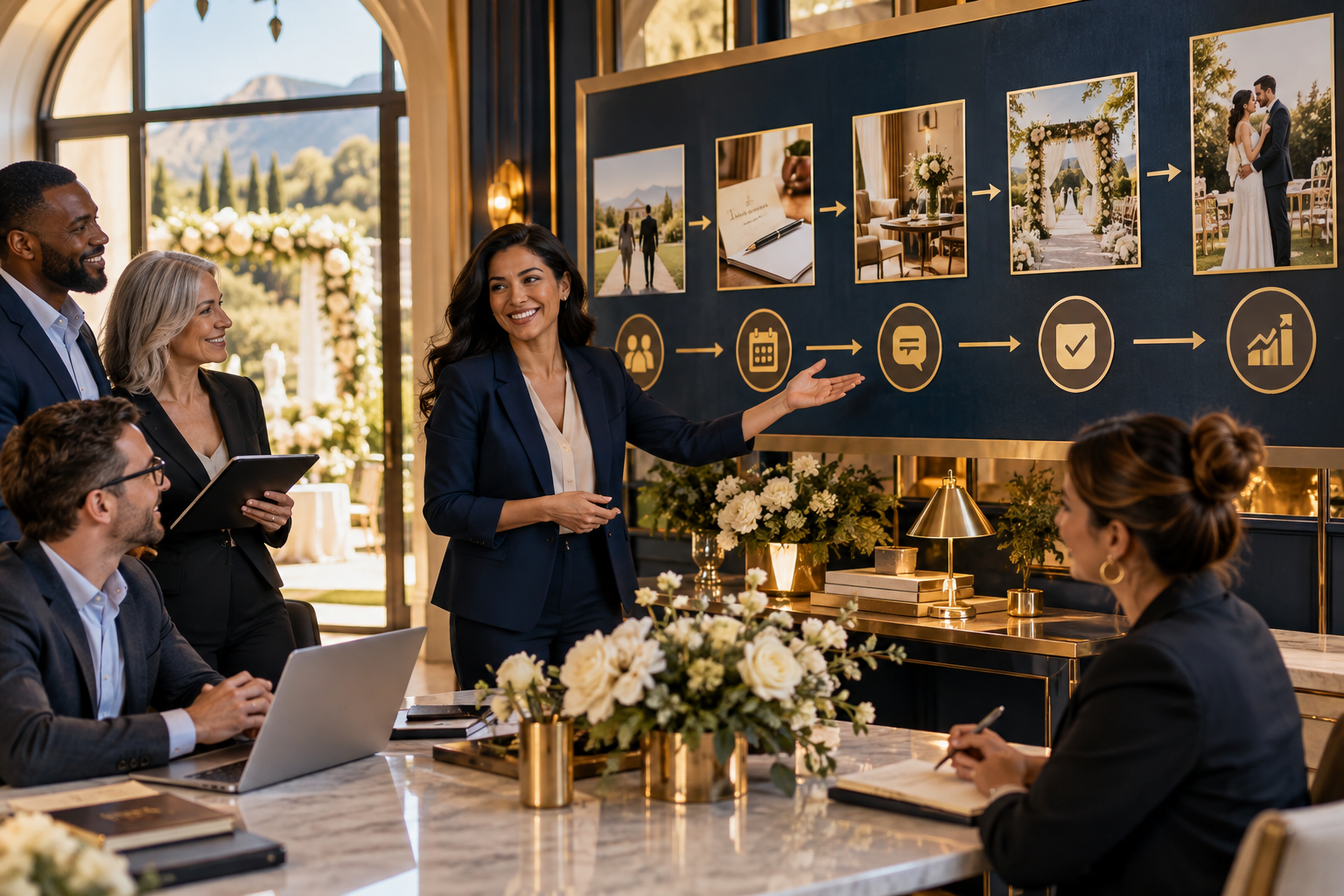
The tour went well. They loved the ceremony space. They took pictures of the reception room. They asked about available dates.
Then... nothing.
Your coordinator sends a friendly email. A few days later, someone sends another. Eventually, the lead gets labeled unresponsive, and everyone moves on.
Maybe they booked somewhere else. Maybe the budget didn't work. Or maybe they left with an unanswered question that nobody thought to ask.
A great tour creates interest. A clear follow-up process helps couples act on it.
That doesn't mean chasing harder. It means helping people make a decision while giving your team a system they can run without you checking every inbox.
Your Wedding Venue Tour Follow Up Starts Before They Leave
The biggest mistake is treating follow-up as something that starts after the tour.
It starts while the couple is still standing in your venue.
Before they leave, ask three questions:
- What feels like the best fit about the space? This tells you what matters to them, not what you assumed would matter.
- What would you still need to understand before deciding? This surfaces concerns about cost, logistics, availability, or the experience itself.
- When are you hoping to make your venue decision? This gives you a timeline you can respect.
Ask whether anyone else needs to be involved. A parent contributing financially might need a cost breakdown. A planner might need vendor access details. Don't assume the people on the tour are the only people weighing the decision.
Then agree on one next step.
For example: “I'll send the estimate and indoor ceremony layout tomorrow. Would it be helpful if I checked back Thursday after you've had time to review them?”
That's more useful than “Let us know if you have questions.”
One creates a shared plan. The other hands the couple another task.
Capture the Details That Make Follow-Up Useful
Personalization is not putting two first names into a template.
It's remembering that they want their grandparents to move comfortably between spaces. It's addressing their concern about rain. It's showing how the room works for their actual guest count.
Your tour notes should capture:
- Preferred date and acceptable alternatives.
- Expected guest count.
- Budget context they chose to share.
- Their priorities and favorite features.
- Unanswered questions or concerns.
- Other people involved in the decision.
- Decision timeline and preferred contact channel.
- Promised information, assigned owner, and next action date.
Keep those notes in a shared customer relationship management system or another consistent location. Not in someone's memory. Not scattered across personal texts.
This is where writing things down becomes an operating standard, not an administrative preference.
If the person who led the tour is off tomorrow, someone else should be able to deliver what was promised without making the couple repeat themselves.
Build a Wedding Venue Tour Follow Up Sequence Around Their Decision
There isn't one perfect schedule for every couple.
Someone selecting a venue this week needs a different pace from someone starting a long planning process. Use the sequence below as a starting framework, then adjust it to the timeline and contact preferences you discussed.
| Touchpoint | Weak approach | Decision-focused approach |
|---|---|---|
| Initial recap | Send the same brochure again | Recap priorities and deliver promised information |
| Question check | Ask whether they saw your email | Address their specific unresolved concern |
| Decision support | Send every package and upgrade | Recommend a relevant option and explain why |
| Timeline check | Push for an immediate answer | Reconnect when they said they would be ready |
| Close the loop | Keep sending reminders indefinitely | Offer a pause and make replying easy |
Each message should earn its place. If it doesn't answer something, clarify something, or offer a useful next step, reconsider sending it.
1. Send a specific recap
Aim to send the recap promptly, ideally the same day or next business day. That's a suggested team standard, not a universal rule. Whatever timing you promise, meet it.
Include the information they requested, a short summary of what matters to them, and one next action.
Here's an illustrative wedding venue follow-up email:
Subject: Your venue tour recap and indoor ceremony plan
Hi Jordan and Casey,
Thanks for visiting today. You mentioned that keeping the ceremony and reception in one place, with comfortable access for your grandparents, is a priority.
I've attached the layout we discussed and an estimate based on your current guest count. The estimate separates venue charges from items you'll arrange with outside vendors.
You also asked about the indoor ceremony option. I've included that layout so you can compare both plans.
Would a short call Thursday help us work through any questions before your next venue visit?
Adapt the details to your actual offering. Never promise accessibility features, layouts, or inclusions that your team hasn't verified.
2. Resolve the biggest open question
Your next touch should build on the conversation, not restart it.
If they were concerned about guest flow, show the relevant layout. If they were unclear about catering requirements, explain those requirements plainly. If they need a second visit with a parent, offer that option.
“Just checking in” tells them you want a response.
“I have the answer to your question about vendor access” gives them a reason to respond.
3. Make the choice easier to understand
Don't respond to uncertainty with a mountain of options.
Recommend the package or date option that best matches what they told you. Explain the tradeoffs, including what it doesn't include.
That principle applies well beyond venue sales: clients often need fewer, clearer options, not a bigger menu.
A useful recommendation might sound like this:
“Based on your guest count and preference for a longer setup window, this option appears to fit best. The alternative costs less, but has a shorter access period. Here's what that would mean for your vendors.”
You're helping them compare. You're not deciding for them.
4. Reconnect on the agreed timeline
If they said they're touring another property Saturday, don't send daily decision requests before Saturday.
Reconnect when you agreed to, and acknowledge their process.
Ask whether they need clarification, more time, or help with the reservation steps. Keep the reply easy. One clear question usually works better than a list of five.
5. Close the loop respectfully
If the agreed timeline has passed and your useful follow-ups haven't received a response, send a final note rather than continuing indefinitely.
For example:
“I don't want to keep adding to your inbox. Would you like us to keep the conversation open, reconnect later, or close your inquiry for now? Any answer is helpful, and you're welcome to reach out when you're ready.”
Honor requests to stop contacting them. Use texting only when they've agreed to that channel, and follow applicable messaging requirements.
Be Clear About Money, Dates, and Booking
A couple shouldn't have to decode what it costs to say yes.
Your estimate should clearly distinguish venue charges, required fees, applicable taxes, optional services, and costs handled by other vendors. Identify assumptions that could change the total, such as guest count or service selections.
Then explain what actually reserves the date.
Does your process require a signed agreement and an initial payment? Is there a temporary hold? When does that hold expire? Use your actual written policy, and make sure the email matches it.
An inquiry is not automatically a reservation. Make that distinction explicit.
If another inquiry creates a genuine availability concern, communicate the facts calmly. Never invent competing interest or imply a deadline that doesn't exist.
Also, check live availability before discussing a date. Yesterday's accurate template can become today's misleading message.
Trust matters more than manufactured urgency.
Give the Process an Owner, Not Just an Automation
Automation can remind staff, deliver standard resources, and flag overdue tasks.
It cannot reliably replace judgment about a couple's concern, a changed date, or a sensitive budget conversation.
Assign one person to own each inquiry, with backup coverage. Define who updates estimates, who verifies availability, and who handles exceptions.
Your wedding venue tour follow up should stop or change when the couple replies, books, declines, requests a pause, or changes direction. Nobody should receive a generic sales reminder after signing their agreement.
Before activating a sequence, test those situations yourself.
Then check a few recent inquiries together as a team. Were promises delivered? Were questions answered? Was the next step visible?
If something slipped, fix the handoff before adding another automated email.
Measure Progress Without Inventing a Success Story
Start with a simple scorecard:
- Recap completion: Were promised recaps sent within your team's standard?
- Next-step coverage: Does each active inquiry have an owner and a dated action?
- Tour-to-booking conversion: How many completed tours become confirmed bookings?
- Decision time: How long do couples take to book or decline?
- Loss reasons: What reasons did couples actually share?
Compare groups of tours that have had similar time to reach a decision. This week's tours shouldn't be judged against inquiries that have had months to convert.
Separate confirmed reasons from guesses. “No response” is an outcome, not proof that your pricing is wrong.
Review patterns before changing the entire process. If couples repeatedly ask the same cost question, improve the estimate. If recaps regularly go late, address workload or ownership.
Better Follow-Up Gets Easier With Outside Perspective
When you're close to the business, every lost booking can feel like a pricing problem. Or a staffing problem. Or proof that you need more leads.
Sometimes the issue is simpler: the next step wasn't clear.
Peer advisory and coaching can help you test that assumption before you spend money solving the wrong problem. Other owners can challenge your interpretation, review an anonymized process, and share relevant experience. Coaching helps turn those observations into a change your team can implement and measure.
At Mentor Pods, we bring business owners together in a small, curated group to work through challenges like these. The value isn't another email template. It's perspective, accountability, and a clearer way to run the business.
Start with one improvement this week: make sure every completed tour has a documented concern, a named owner, and an agreed next step.
That's a process your team can use. And an experience couples can trust.
You don't have to figure it out alone. If you're at a stage where the right room could change everything, we'd love to hear your story. Start a conversation with us.

Matt Radicelli
Founder & Lead Advisor
Matt Radicelli built Mentor Pods after spending 15 years scaling businesses and realizing the loneliest seat in the room was always at the top. He created the peer-advisory model he wished existed when he needed it most.
Q4 2026 Pods
Join a curated group of entrepreneurs who meet weekly to share real challenges, test ideas, and hold each other accountable.
Start a Conversation