Simple Scales. Complicated Stalls.
More systems do not always mean better results. Sometimes the fastest path to growth is removing friction, not adding to it.
Matt Radicelli
Coach & Advisor
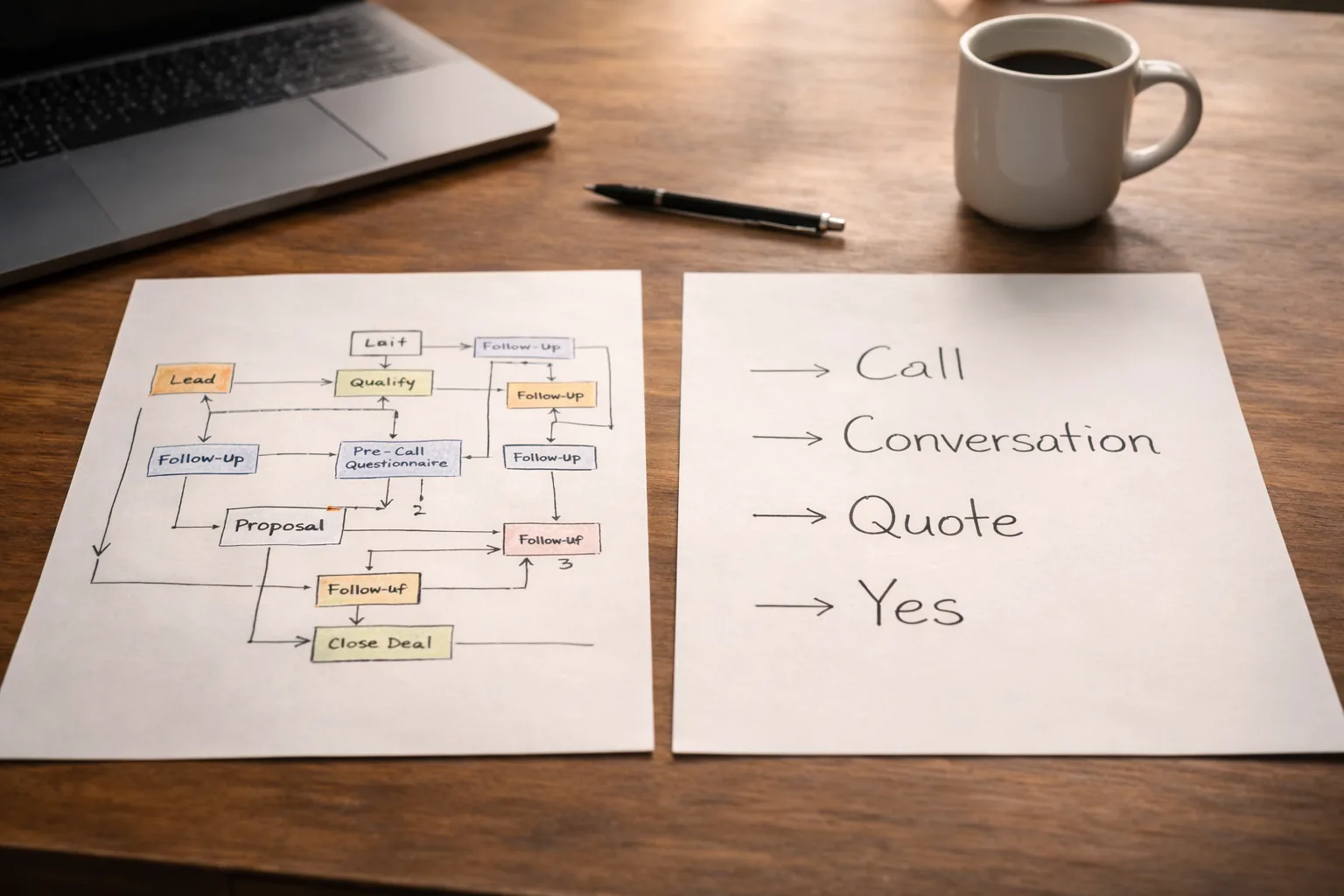
A few weeks ago, a Pod member walked us through her entire sales process during one of our sessions. She'd been frustrated for months. Leads were coming in, but deals weren't closing the way they used to. She couldn't figure out why.
So I asked her to map it out. Start to finish. Every step from the moment a lead comes in to the moment a deal closes.
By the time she was done, I counted 14 steps. Fourteen.
She had automations triggering other automations. Three different follow-up sequences running simultaneously. A qualification form, then a pre-call questionnaire, then a discovery call, then a proposal, then a follow-up to the proposal, then a second follow-up to the follow-up. Each stage had its own set of rules and conditions and exceptions.
It was impressive, honestly. She'd clearly put a lot of thought and effort into building it. But it wasn't working. Her close rate had been dropping steadily for months, and she couldn't understand why.
So I asked her one question.
"What did your sales process look like when business was really good?"
She laughed. "I'd get a call. We'd talk. I'd send a quote. They'd say yes."
Four steps. That was it.
The Optimization Trap
Somewhere along the way, she'd "optimized" herself into a mess. And I put that word in quotes intentionally, because what she thought was optimization was actually complication disguised as progress.
She's not alone. I see this pattern constantly with the business owners I coach inside Mentor Pods. Smart, driven people who are stuck. Not because they're doing too little. Because they're doing too much.
Here's how it happens. Business starts growing. Revenue's up. Clients are coming in. And you think, okay, I need to professionalize this. I need systems. I need structure. So you add.
A new CRM. A new funnel. A new service tier. A new process for onboarding. A new layer of approval before anything goes out the door. A new automation to handle the thing you used to handle with a quick phone call.
Each addition made sense at the time. Each one felt like a smart move. You probably even felt good about it. "Look at us, running a real operation."
But stacked together over months and years? You've built a machine that's harder to run than the business itself. You've created so much infrastructure around the work that the infrastructure has become the work.
And the worst part? Most of it isn't generating revenue. It's generating busywork that feels productive but doesn't actually move anything forward.
Why Complexity Feels Like Progress
This is the part that trips people up. Because adding things feels proactive. It feels like growth. When you install a new system or build a new workflow or create a new process, there's a sense of accomplishment attached to it. You're improving. You're scaling. You're being a responsible business owner.
But there's a difference between building systems that serve the business and building systems that serve themselves. And the line between the two is thinner than most people realize.
Think about it this way. Every step in a process is a potential point of friction. Every handoff is a place where something can stall, get lost, or fall through the cracks. Every automation is another thing that can break quietly in the background while you assume it's working.
When that Pod member had four steps, the path from lead to close was clear. The prospect felt it too. Fast response. Direct conversation. Clear quote. Done.
At 14 steps, the prospect was being funneled through a gauntlet. By the time they reached the actual conversation, they'd already been filtered, questioned, sequenced, and followed up with so many times that the energy was gone. The human connection that originally closed deals had been engineered out of the process.
She didn't need a better funnel. She needed fewer funnels.
The "Can This Be Simpler?" Test
Here's the challenge I gave her, and the same one I'm giving you.
Pick one area of your business this week. Just one. Your sales process. Your client onboarding. Your service delivery. Your internal communication. Whatever feels the heaviest or the most clogged right now.
Then ask one question: can this be simpler?
Not "how can I optimize this?" Not "what tool can I add to make this better?" Just: can this be simpler?
How many steps does this process actually need? Not how many does it currently have. How many does it need to get the result you're after?
Strip it down. Remove the steps that don't directly lead to a closed deal, a happy client, or a delivered product. If something exists because "we've always done it that way," that's not a reason. That's a habit. And habits that don't serve you are just weight you're carrying for no reason.
What Simplifying Actually Looks Like
When I work through this exercise with Pod members, the resistance usually shows up in the same places.
"But we need the qualification form so we don't waste time on bad leads." Maybe. Or maybe a two-minute phone conversation tells you everything that form does, and the prospect actually feels heard instead of processed.
"But the three follow-up sequences are important because people don't respond right away." Sure. But are three sequences doing meaningfully better than one well-written follow-up? Have you actually checked?
"But we added that approval step because of that one time something went out with a mistake." Understood. But is one past mistake worth adding friction to every single project going forward?
The answers aren't always obvious. Sometimes a step really is necessary. But more often than you'd expect, the honest answer is: we added this because it made us feel more in control, not because it made the business work better.
Simplifying doesn't mean being careless. It means being intentional. It means every step earns its place in the process, and anything that doesn't get cut.
Simple Is a Competitive Advantage
The businesses that grow fastest aren't the ones with the most sophisticated systems. They're not the ones with the most automations, the longest playbooks, or the most layers of process.
They're the ones that do fewer things, better, with less friction.
They're faster to respond because there are fewer steps between the request and the action. They're easier to work with because the client experience isn't cluttered with unnecessary touchpoints. They're more profitable because they're not spending time and money maintaining complexity that doesn't generate returns.
Simple scales. Complicated stalls. Every time.
That Pod member? She went back and rebuilt her sales process. Cut it from 14 steps down to five. Within a month, her close rate was back up. Not because she added something new. Because she finally took away everything that was in the way.
So here's your move this week. Pick one thing. Ask if it can be simpler. And see what happens when you stop adding and start subtracting.

Matt Radicelli
Founder & Lead Advisor
Matt Radicelli built Mentor Pods after spending 15 years scaling businesses and realizing the loneliest seat in the room was always at the top. He created the peer-advisory model he wished existed when he needed it most.
Q4 2026 Pods
Join a curated group of entrepreneurs who meet weekly to share real challenges, test ideas, and hold each other accountable.
Start a Conversation