Photo Booth Delivery Scheduling: How to Coordinate Multiple Events in One Day
Coordinate multiple photo booth events with realistic delivery windows, clear equipment assignments, and backup plans that protect your clients and your margins.
Matt Radicelli
Coach & Advisor
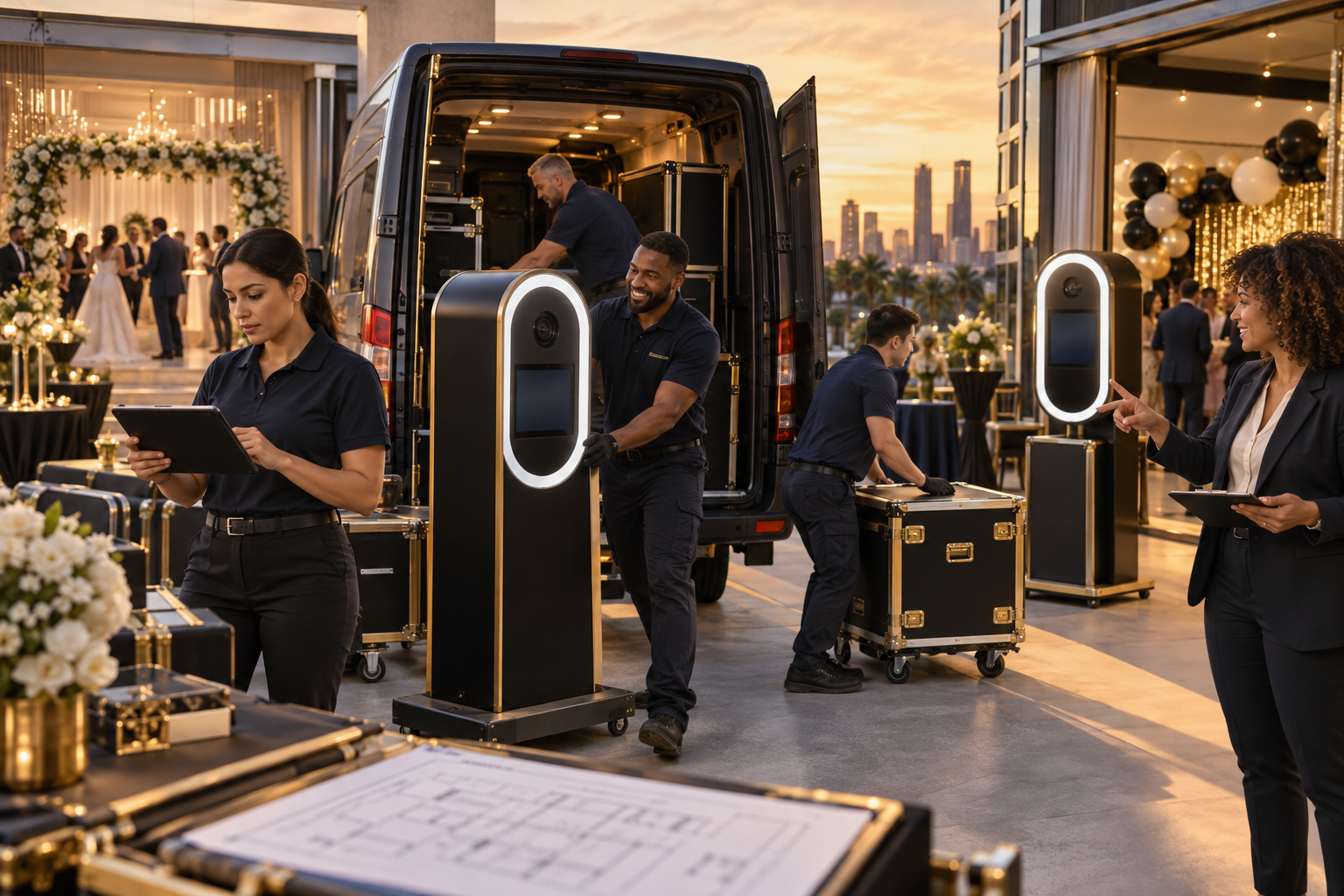
Three bookings on Saturday looks like growth. Until two venues require the same load-in window, your only printer backup is across town, and the person delivering the last booth is also supposed to operate the first one.
The problem isn't necessarily too many events. It's a schedule built around event start times instead of everything required to deliver them.
Photo booth delivery scheduling needs to account for people, equipment, vehicles, venue access, and recovery time. If any one of those is double-booked, your calendar is promising something your operation cannot deliver.
Here's how to build a schedule your team can actually execute without making you the emergency driver every weekend.
Build Photo Booth Delivery Scheduling Around Access Windows
An event starting at 6 p.m. doesn't tell you when your team needs to arrive.
A ballroom might allow setup all afternoon. A downtown venue might give vendors a narrow loading dock reservation. A corporate activation might require equipment inspection before doors open.
Before confirming delivery commitments, collect:
- Venue access: Earliest permitted arrival and latest permitted setup completion.
- Service times: When the booth must be tested and ready, when service begins, and when it ends.
- Loading conditions: Parking, stairs, elevators, dock reservations, and distance to the setup location.
- Site requirements: Power, connectivity, credentials, insurance documentation, and security procedures.
- Pickup restrictions: Earliest teardown, final removal deadline, and whether overnight storage is permitted.
- Contacts: Who can authorize access and who can resolve problems on event day.
Confirm these details with the person responsible for venue operations, not just the client. A client may reasonably assume you can arrive whenever you want.
An unconfirmed access window is an unresolved scheduling risk. Make it visible before someone builds a route around it.
Schedule the Full Deployment, Not Just the Rental
A booth might operate for a few hours while consuming most of a crew member's day.
Your schedule needs to show that full commitment. Otherwise, apparently available people and equipment will get assigned twice.
Map each deployment through these stages:
- Warehouse preparation and loading.
- Travel to the venue.
- Parking, check-in, and unloading.
- Transport to the setup location.
- Assembly, configuration, and testing.
- Service coverage or an approved handoff.
- Teardown and loading.
- Return travel, inspection, and reset.
Separate booth occupancy from staff occupancy. Equipment can remain at a venue while a delivery crew leaves, but only if the service model, security arrangements, and attendant handoff support that plan.
The same applies to vehicles. A van cannot serve another route while it's parked at an event holding supplies the attendant still needs.
Work backward from the ready time
Suppose a booth must be ready at 5:30 p.m. For illustration, you allow 45 minutes for setup and testing, 20 minutes for unloading and venue access, 40 minutes for travel, and 25 minutes of contingency.
That puts departure at 3:20 p.m., with warehouse loading completed beforehand.
Those aren't universal benchmarks. Use your own observed times by booth type and venue. A simple digital booth and a custom branded activation should not share the same setup assumption.
Choose the Delivery Model That Fits the Day
There isn't one right staffing model for every booking. The right choice depends on geography, access windows, equipment complexity, and service expectations.
| Delivery model | Useful when | Main scheduling risk |
|---|---|---|
| Attendant delivers and operates | One person can safely transport, set up, and run the equipment | The attendant is unavailable for other deliveries during service |
| Dedicated delivery crew | Multiple booths can be installed before attendants arrive | Handoffs and pickup routes need clear ownership |
| Mixed deployment | Different events require different levels of support | Roles become confusing unless every assignment is explicit |
A dedicated delivery crew can create capacity, but it also adds coordination and labor costs. It isn't automatically more profitable.
Before changing your model, review what each photo booth booking actually earns. Include preparation, travel, setup, teardown, and return handling, not just attendant hours during the event.
An extra booking is useful only if you can fulfill it reliably at an acceptable margin.
Assign Specific Equipment, People, and Vehicles
“Booth available” is not a complete resource assignment.
You need to know which booth, which printer, which backdrop, which transport vehicle, and which trained people are committed.
Create a deployment record for every event with:
- Event identifier and venue address.
- Assigned booth and accessory identifiers.
- Required prints, props, branding files, and consumables.
- Delivery lead, service attendant, and pickup lead.
- Vehicle assignment and loading order.
- Access, ready, service, and removal times.
- Venue contact and escalation contact.
- Backup equipment location and availability.
Check shared accessories carefully. Two available booths don't create two complete packages if both bookings require your only compatible printer or premium backdrop.
For photo booth delivery scheduling, inventory availability must cover the entire period from preparation through return and reset. Don't mark a unit available when service ends if it's still waiting for pickup.
Use one shared schedule as the source of truth. A spreadsheet can work if ownership and updates are controlled. Software can help as complexity grows, but it won't fix missing information.
The principle is simple: if it isn't written down, it didn't happen. Route changes cannot live only in the owner's text messages.
Route Around Constraints Before Geography
The shortest route is not always the workable route.
Start with the least flexible commitments: restricted dock access, hard setup deadlines, complex installations, and fixed pickup windows. Then arrange flexible stops around them.
Consider this illustrative Saturday:
- A corporate activation requires installation before noon.
- A wedding venue permits afternoon delivery for evening service.
- A private party allows access only shortly before guests arrive.
The corporate installation goes first because its deadline is fixed. The wedding may fit next because equipment can be left securely with venue approval. The private party needs its own protected arrival window, potentially with another crew.
Don't force all three onto one vehicle just because the locations look close on a map.
Also build the pickup route before approving the delivery route. Multiple events ending at the same time can create a problem that early delivery doesn't solve.
The day is feasible only when both deployment and recovery work. Include driver availability, safe working hours, vehicle capacity, and venue removal deadlines in that decision.
Build Buffers Where Delays Actually Happen
A buffer shouldn't be a random cushion pasted onto every job.
Place contingency around known sources of uncertainty:
- Traffic during the actual travel window.
- Shared loading docks and freight elevators.
- Long equipment carries or difficult parking.
- Complex branding, printing, or connectivity checks.
- Tight transitions between deliveries.
- Late access or delayed event endings.
Keep the distinction clear: expected unloading time is work, not contingency. If unloading normally takes 20 minutes, putting 20 minutes in the schedule doesn't create a buffer.
Be especially cautious about reusing the same booth at two events in one day. That transition must include teardown, loading, travel, unloading, reset, testing, and contingency. It must also survive the first event finishing late.
If the second booking works only when everything goes perfectly, assign another unit or change the commitment.
Make Handoffs and Exceptions Predictable
Your team should know what “ready” means without calling you.
Require a completion check before the delivery crew leaves:
- Booth is positioned in the approved location.
- Equipment is stable and cables are safely managed.
- Correct event graphics and settings are loaded.
- Capture, printing, and delivery functions are tested as applicable.
- Supplies are accessible to the attendant.
- The attendant or designated contact has accepted the handoff.
Set simple status updates: departing, arrived, setup blocked, tested and ready, service complete, and returned.
Then define escalation triggers. A crew should flag a delay as soon as it threatens the ready time, not after that time has passed.
Assign one person to coordinate changes. Give that person authority boundaries for rerouting, dispatching backups, and communicating revised expectations. Drivers should provide updates only when safely stopped.
Your backup staffing plan should name available people, their skills, their availability, and how they will reach the equipment. A list of phone numbers isn't enough.
Review the Schedule Before Adding More Bookings
After a busy day, compare planned times with actual times. Track ready-time performance, setup overruns, extra travel, missing items, emergency dispatches, and labor by booking.
Look for recurring causes rather than blaming the last person involved.
Does one venue consistently require longer access time? Are sales promises creating impossible transitions? Is your most experienced attendant covering gaps that should have been addressed before dispatch?
Those are business decisions, not just routing problems.
This is where peer advisory and coaching can accelerate progress. Other owners can question assumptions you've stopped noticing. A coach can help turn a recurring frustration into a capacity rule, a pricing decision, or a measurable operating standard.
At Mentor Pods, we work through those connections between operations, financial clarity, and owner dependency. In a small, curated group, you can pressure-test a decision before another busy weekend tests it for you.
Good photo booth delivery scheduling makes capacity visible before you sell it. Start with your next crowded date. Confirm access windows, assign actual resources, build both routes, and resolve the tightest transition.
The goal isn't a calendar packed with bookings. It's a day your team can deliver confidently without depending on you to rescue it.
You don't have to figure it out alone. If you're at a stage where the right room could change everything, we'd love to hear your story. Start a conversation with us.

Matt Radicelli
Founder & Lead Advisor
Matt Radicelli built Mentor Pods after spending 15 years scaling businesses and realizing the loneliest seat in the room was always at the top. He created the peer-advisory model he wished existed when he needed it most.
Q4 2026 Pods
Join a curated group of entrepreneurs who meet weekly to share real challenges, test ideas, and hold each other accountable.
Start a Conversation