You Don't Need to Learn to Code. You Need to Learn to Command.
The skill that matters now is not coding. It's clarity. If you can describe the outcome, AI can handle the how.
Matt Radicelli
Coach & Advisor
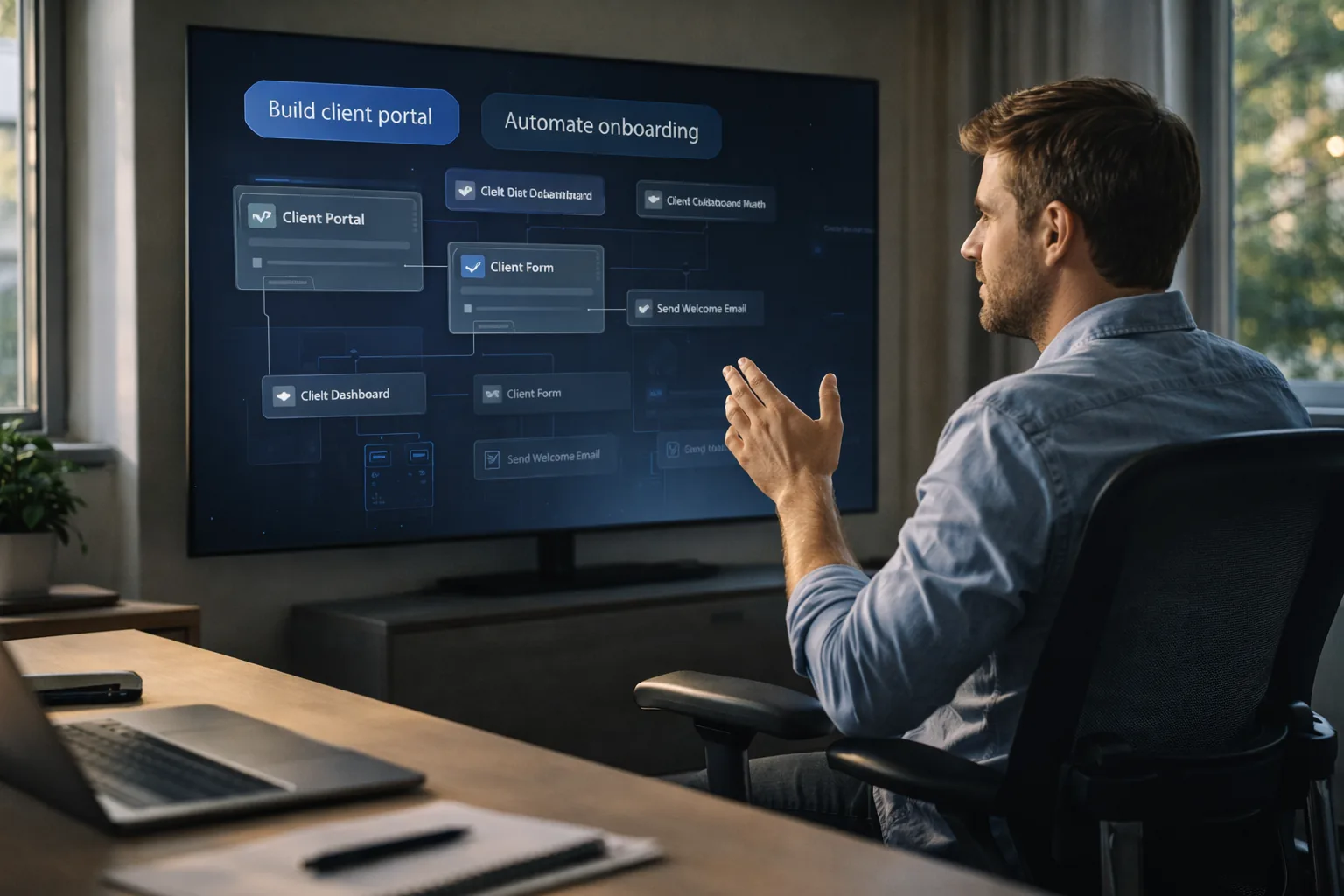
Six months ago I watched a business owner build a custom client portal in an afternoon.
No developer. No agency. No six-week timeline and $15K budget.
He sat down, described what he wanted to an AI tool, and it built the thing. Working buttons. Login system. Client dashboard. All of it. Functional. In a few hours.
This guy can't write a line of code. Couldn't tell you the difference between JavaScript and Java. He's never opened a terminal or looked at a line of CSS in his life. But he just told the tool what he needed and it figured out the how.
I sat there watching him click through the finished product and I remember thinking: the game just changed and most teams and business owners have no idea.
The Old Advice is Dead
For years, the conventional wisdom was "learn to code."
If you wanted to build something for your business, you had two options. Learn programming yourself or pay someone a lot of money to do it for you.
That meant bootcamps, online courses, dev agencies, freelance developers, and budgets that made most small business owners give up before they started.
That app idea? Shelved. That internal tool you wished existed? Too expensive. That manual workflow you've been doing by hand for three years? Just keep doing it, because automating it costs more than your time is worth.
I watched so many teams and business owners sit on great ideas because the barrier to building them was too high. The ideas weren't the problem. The cost of execution was.
That barrier is gone now. Not lowered. Gone.
In the last month alone, I built three working apps. Zero code written. Just me describing what I needed to an AI tool clearly enough that it could build it.
Three Real Examples
Let me show you what this actually looks like in practice.
App #1: Should I Rent or Buy Calculator
I kept seeing business owners wrestle with the same question: "Should I rent this piece of equipment or just buy it?"
Office printer. Company vehicle. That specialized tool you only need sometimes.
The math isn't complicated, but nobody does it. So they either overspend buying something they barely use, or keep renting something they should have bought two years ago.
I built a calculator that answers that question. You plug in the rental cost, purchase price, and how often you'd use it. It tells you the breakeven point. Took me a couple of days.
Check it out here.
App #2: Job Market Pay Rate Database
Yesterday a client said, "I'm so frustrated. I have no idea what I should be paying the people working with me."
Fair. Market rates are all over the place depending on location, experience, and role. So I built a searchable database. You type in the job title and location, it shows you what people are actually paying for that role. Real data. Not guesses.
You can try it out here.
App #3: Retirement Calculator
This one's personal. I wanted a simple tool that shows: if I save X per month starting now, what will I actually have at retirement?
Not some bloated financial planning software with seventeen fields and a sales call at the end. Just a clean, honest calculator.
Built it in a couple hours. You can explore it here.
None of these required me to write code. I described the problem. I described what the tool needed to do. The AI built it.
These aren't demos. They're real tools solving real problems.
What This Actually Means for Your Business
That workflow you've been doing manually? The one where a client fills out a form, then you copy the info into a spreadsheet, send a confirmation email, and create a task in your project management tool?
You can describe that entire sequence to an AI agent and have it automated. Not in six weeks. By Friday.
That internal tool you've always wanted? The one that tracks client progress, shows your team what's due, and sends you a weekly summary?
You can build a working version this week. Not a mockup. A working tool.
That app idea you shelved because a developer quoted you $15K and an eight-week timeline?
It might cost you an afternoon and a clear description of what you need.
I'm not exaggerating. I've seen business owners with zero technical background build client portals, booking systems, and internal apps that would have cost tens of thousands of dollars a few years ago. And they did it by talking to a tool the same way they'd talk to a smart employee.
"Here's what I need. Here's why. Here's what it should look like when it's done."
That's it.
The Real Skill Isn't Technical Anymore
Here's the catch. "Describe what you want" sounds simple but it's actually a skill. And it's the skill that separates the business owners who are getting massive value from these tools and the ones who try them once and give up.
The people getting the most out of AI aren't the most technical founders.
They're the ones who can think clearly about their problems and communicate what they need in plain language. They know their business well enough to articulate what's broken, what the ideal outcome looks like, and what the steps are in between.
Which, if you think about it, is what good business owners already do every day. When you onboard a new employee, you describe processes. When you pitch a client, you describe outcomes. When you plan a project, you describe the steps from start to finish.
That's the same skill. You've been practicing it for years. You just didn't know it was about to become the most valuable capability in business technology.
Here's what you actually need to know: enough about your business to explain what you want built. And enough about the basics of how these tools work to guide them in the right direction when they get stuck.
You don't need to be a developer. But you do need to understand what you're asking for well enough to know if what the tool gives you is close or way off.
Think of it like this: you don't need to be a mechanic to drive a car. But you should probably know what the gas pedal does.
What's the problem? What triggers it? What's the ideal outcome? What does "done" look like?
That's the new literacy.
How to Start This Week
You don't need to overhaul your business or commit to a new platform. You need about 30 minutes and one specific problem.
Pick one manual process that drives you crazy. Something repetitive, time-consuming, or error-prone. The thing your team complains about. The thing you keep saying you'll fix someday.
Describe it out loud like you're explaining it to a smart new hire on their first day. What triggers the process? What are the steps? What information moves where? What does "done" look like? Be specific. The clearer you are, the better the output.
Then take that description to an AI tool and see what happens. ChatGPT, Claude, tools like Lovable or Bolt... whatever you have access to. You don't need to pick the perfect tool. You need to start the conversation. Paste in your description and say "build this for me" or "automate this workflow" and see what comes back.
You'll be surprised how far a clear description gets you. It won't be perfect on the first try. But it'll be a working starting point. And from there, you refine. You describe what's not right. You add detail. You iterate. Each round gets closer to exactly what you need.
The Question That Changes Everything
Once you do this once, something shifts in how you see your entire business. The question stops being "what can I afford to build?" and becomes "what can I describe well enough to build?"
That's a completely different lens. Suddenly every inefficiency in your business is a building opportunity. Every manual workaround is a candidate for automation. Every idea you shelved because of cost is back on the table.
And the barrier to trying is almost zero. The worst thing that happens is the tool doesn't get it right and you've lost an afternoon. The best thing that happens is you build something that saves your team hours every week for the rest of the year.
You don't need a technical co-founder or a development budget. You just need to know your business well enough to describe what needs to happen. And you need the basics of how these tools work so you can guide them when they're off track.
That's the shift. And you can start today.

Matt Radicelli
Founder & Lead Advisor
Matt Radicelli built Mentor Pods after spending 15 years scaling businesses and realizing the loneliest seat in the room was always at the top. He created the peer-advisory model he wished existed when he needed it most.
Q4 2026 Pods
Join a curated group of entrepreneurs who meet weekly to share real challenges, test ideas, and hold each other accountable.
Start a Conversation