A lot of business advice is about working harder and doing more.
That advice isn’t wrong. But it misses something important. The real question isn’t how hard you’re working. It’s whether you’re pushing in the same direction long enough to create momentum.
That’s where Jim Collins’ Flywheel Effect comes in.
And if you’ve never heard of it, this might be the most important business concept you learn this year.
What Is the Flywheel Effect?
Jim Collins introduced the flywheel concept in his book Good to Great, and it’s become one of the most powerful frameworks for understanding how businesses actually grow.
Here’s the basic idea:
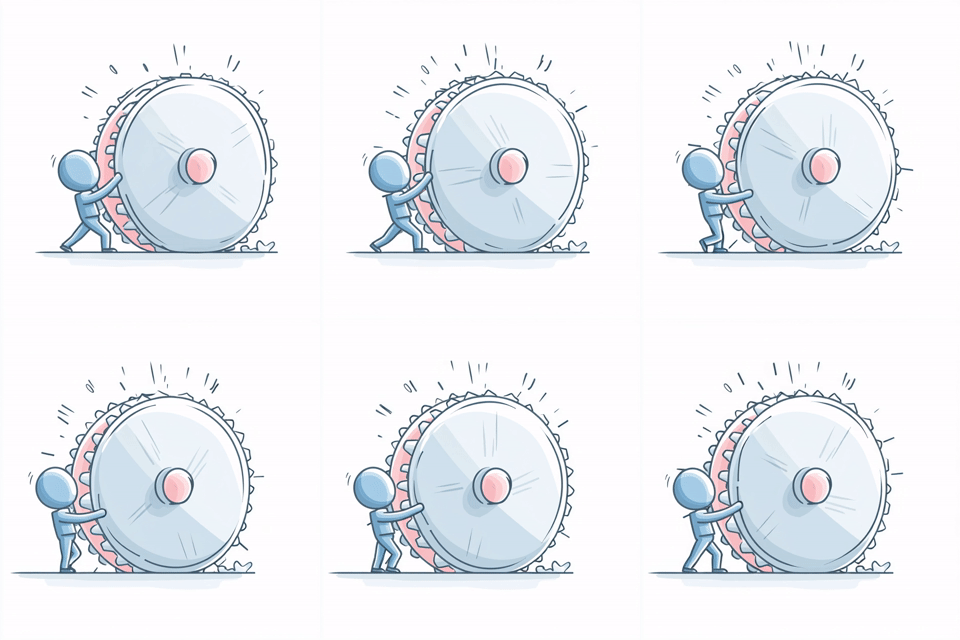
Imagine a massive metal flywheel. It weighs 5,000 pounds and sits horizontally on an axle.
Your job is to get it spinning as fast as possible. Start pushing and the wheel barely moves. You push again. Still slow, maybe you get one full rotation after an hour of effort.
You keep pushing. Same direction and effort. Over and over.
It feels like nothing is happening. But something is happening that you can’t feel yet. Every push is adding to the momentum and the wheel is storing energy.
Then, somewhere around turn 50 or 100, the wheel starts moving faster. And faster. Suddenly it’s spinning on its own, you can barely keep up.
From the outside, it looks like an overnight success. From the inside? You were pushing that same wheel in the same direction for months when nobody was watching.
That’s the Flywheel Effect. And it’s exactly how businesses break through.
The Searing Logic: If A, Then B, Then C
The flywheel isn’t random. It’s not just “do more things and hope something works.”
One of the most important parts of Collins’ framework is what he calls “searing logic.”
It’s a specific sequence of actions where if A happens, B must happen. If B happens, C must happen. Each step logically leads to the next. And when the sequence repeats over and over, momentum builds.
Here’s an example from Amazon’s flywheel (one Collins studied):
- Lower prices → attracts more customers
- More customers → attracts more third-party sellers (more selection)
- More selection → attracts even more customers
- More customers → justifies better infrastructure
Better infrastructure → lowers costs - Lower costs → enables lower prices (back to step 1)
See how each step feeds the next? That’s searing logic.
It’s not “do everything and see what sticks.” It’s “if we do this, that must follow.”
And when you run that loop enough times, it becomes unstoppable.
Why Most Businesses Never Build a Flywheel
Here’s what kills momentum for most businesses:
They push the wheel five times, don’t see results, and switch directions.
New strategy, offer, platform or funnel.
They never build momentum because they never push long enough in the same direction.
Every time they change course, the flywheel resets to zero. And they wonder why nothing’s working.
How to Build Your Flywheel
If you want to build a flywheel for your business, here’s how to start:
1. Identify Your Core Loop
What’s the repeatable sequence of actions that drives your business?
For a service business, it might look like this:
- Deliver great work for a client
- Client shares results with their network
- Referrals come in
You deliver great work again (back to step 1)
For a software company:
- Free trial attracts new users
- Great onboarding gets them to their first win
- They upgrade to paid
- You use revenue to improve the product
- Better product attracts more free trials (back to step 1)
Write down your loop. What has to happen for your business to grow? What’s the chain reaction?
2. Test the Searing Logic
Does each step logically lead to the next?
If you deliver great work, does it actually lead to referrals? Or are you assuming it does? If people sign up for your free trial, does your onboarding actually get them to their first win? Or do most of them drop off?
The loop only works if the logic is sound. If there’s a gap, fix it before you push harder.
3. Push in the Same Direction
Once you’ve identified your loop and tested the logic, commit to it. Don’t change your strategy every quarter or chase the next shiny tactic. Push the same wheel. Over and over. Even when it feels slow.
Momentum doesn’t come from doing more things. It comes from doing the same things long enough that they compound.
4. Measure the Momentum
You can’t feel momentum in the early days. But you can measure it.
Track the metrics that matter in your loop:
- How many referrals are you getting per month?
- How many trial users are converting?
- How fast is your onboarding getting people to their first win?
If the numbers are improving, the wheel is spinning. Even if it doesn’t feel like it yet.
The Boring Middle Is Where the Magic Happens
Here’s the hardest part about the flywheel:
The breakthrough doesn’t happen in the first 10 pushes. It happens around push 50. Or 100. Which means most of your effort happens in what I call the boring middle.
You’re showing up every day. Doing the work, seeing slow, incremental progress.
It doesn’t feel like “the thing” that’s going to change everything. But it is.
Every email you send, client you deliver for, piece of content you publish. It’s all adding to the wheel.
Your Flywheel Is Already Spinning
If you’ve been consistent in your business for more than a few months, your flywheel is already spinning.
The momentum is building and the energy is storing. You’re closer to the breakthrough than you think!
So identify your loop, test the logic, then push.
Your flywheel is already spinning. Don’t stop pushing now.
Further Reading on the Flywheel Concept
If you want to go deeper on Jim Collins’ Flywheel framework, here are some resources:
- Jim Collins’ Overview of the Flywheel Effect
- Turning the Flywheel: A Monograph to Accompany Good to Great by Jim Collins
- Good to Great by Jim Collins (where the concept was first introduced)
The visual diagrams and case studies in these resources are incredibly valuable for understanding how different companies have built their own flywheels.