More teams are drowning in data right now.
They’ve got dashboards with 47 different metrics. Color-coded charts. Weekly reports that take 45 minutes to review. And at the end of all that, they still don’t know if they’re winning or losing.
Here’s the problem: when you track too many things, you pay attention to nothing. Your brain can’t hold 47 priorities. It can barely hold seven.
So you end up checking the numbers that make you feel good and ignoring the ones that don’t. Or worse, you stop looking at any of them because it’s too overwhelming.
That’s where scorecards come in.
What Makes a Scorecard Different from a Dashboard
A dashboard shows you everything, while a scorecard shows you what matters.
We use the term “scorecard” for a reason. It doesn’t lie, and there’s a winner and a loser.
But you have to know what game you’re playing in order to know how to keep score. And in order to understand what’s happening, you have to understand how to play the game.
The Four Scorecards Every Business Needs
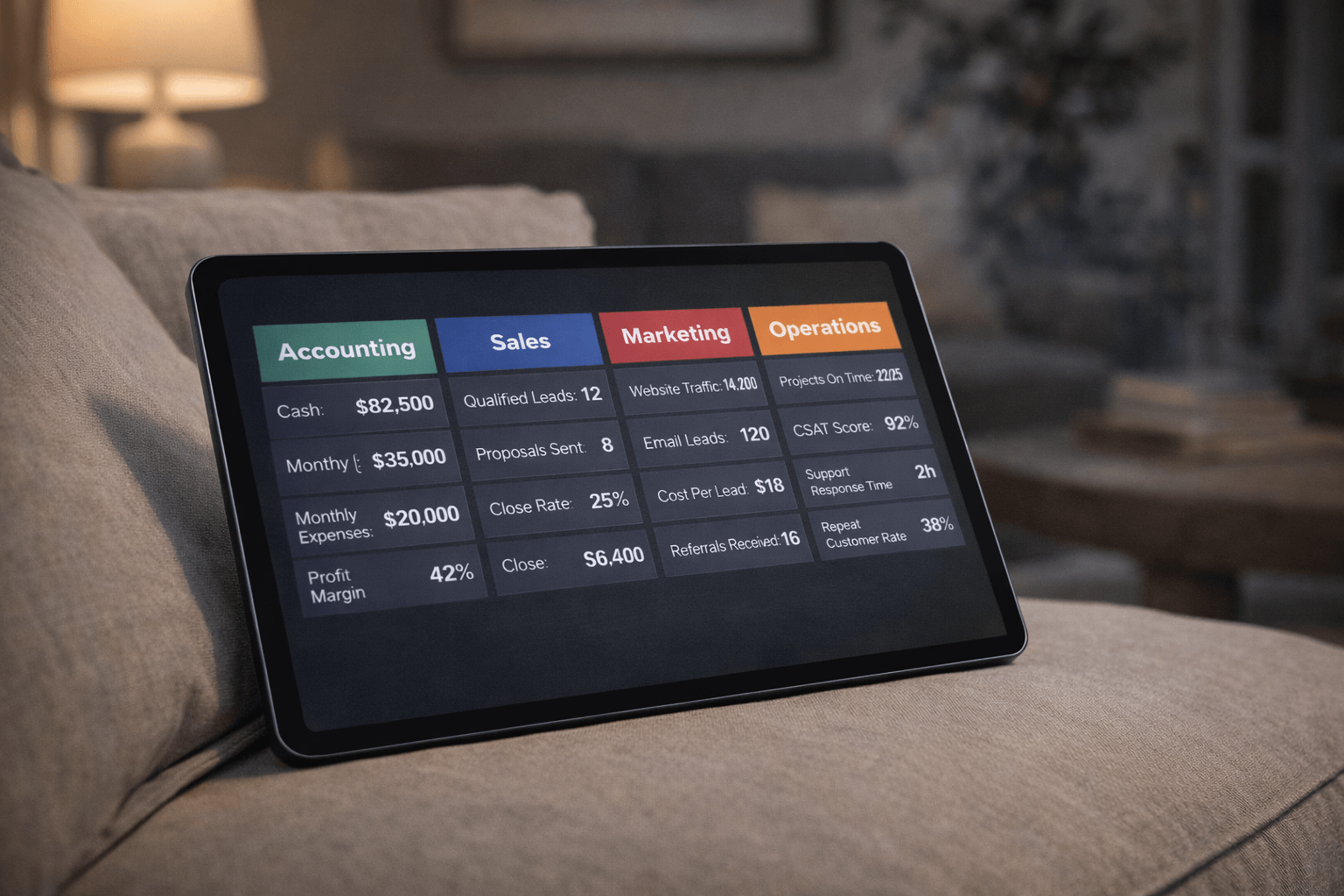
We recommend four different scorecards for any business:
- Accounting (the money)
- Sales (the pipeline)
- Marketing (the lead generation)
- Operations (the quality control)
Here’s why we keep them separate. As your business grows, the individuals or departments responsible for what’s inside those scorecards generally do not have the same scope of work.
Your marketing person doesn’t need to know what’s on your accounting scorecard. And you don’t need your sales manager to know what’s on your operations scorecard.
Keeping them separate means each person only sees what they need to see. No noise or distraction. Just the numbers they can actually influence.
The Beach Test
Here’s a little test we do to help our Pod members figure out what should go on their scorecards.
Imagine you’re sitting on a beach. You’re relaxed and on a vacation.
The beach server walks over, hands you a drink, and gives you a small piece of paper with just a couple numbers scribbled on it.
What would you want on that piece of paper? What numbers would cause you to either:
a) Jump up, grab your phone, and make a call because something’s wrong
b) Take a deep breath and know everything’s okay with your business
Those are your scorecard numbers. It’s not the metrics you post on social media or the 47 data points your software can track. It’s the 3-5 numbers per department that tell you the truth.
What Goes on Each Scorecard
Let’s break down what typically belongs on each one. Please note, these are generic examples that might not work for your business. Most business would benefit from customizing these.
1. Accounting Scorecard
This is your money scorecard, the fundamentals. This tells you: Can we make payroll? Are we profitable? Do we have a runway?
Examples:
- Revenues
- Cost of Goods Sold (Variable Expenses)
- Gross Margin
- Fixed Expenses
- Net Profit
- Bank Account Balances
- Liabilities & Credit Balances
2. Sales Scorecard
This is your pipeline scorecard of what’s coming. This shows you: Are we going to hit our revenue goals 60-90 days from now?
Examples:
- Number of Leads
- Number of Meetings / Consults
- Deals Won
- Deals Won Revenue
- Closing Ratio (Rolling Average)
- Average Dollar Sale
3. Marketing Scorecard
This is your lead generation scorecard. Where leads come from. This tells you: Are we filling the top of the funnel? Is our marketing actually working?
Examples:
- Leads per Inquiry Source
- Website Traffic
- Contact Form Conversion
- Socials & Engagement
- Email Marketing Performance Stats
- General Marketing Activity Notes
4. Operations Scorecard
This is your quality control scorecard. This tells you: Are we delivering well? Are we keeping our promises? Are customers happy? Are we building a reputation we’re proud of?
Examples:
- Total Orders Fulfilled
- On-Time Delivery Score
- Customer Satisfaction Rate
- Average Response Time
- Labor Efficiency Ratio
- Error / Refund Rate
The Order Matters
If you’re just getting started with scorecards, this is the order we recommend you work on.
Start with accounting. Get clarity on your money. You can’t build a business if you don’t know where you stand financially.
Then do the sales because it tells you what’s coming. If your pipeline is healthy, you’ll have revenue in 60-90 days. If it’s dry, you need to know now.
Next, go for marketing. It fills the pipeline. If sales is slowing down, you need to know if it’s a marketing problem or a closing problem.
Finally, operations. Once you have money coming in and a steady pipeline, you need to make sure you’re delivering quality. This is what keeps customers coming back and referring others.
Master one before moving to the next.
Keep It Simple
The biggest mistake is to track everything. To build a scorecard with 15 metrics. Then 20. Then 30. You’ll stop looking at it because it’s too much.
Your scorecard should fit on one page. Ideally, one small piece of paper. If you can’t glance at it in 30 seconds and know if you’re winning or losing, it’s too complicated.
Start with 3-5 metrics per scorecard. You can always add more later. But chances are, you won’t need to.
The Numbers Don’t Lie
In Mentor Pods, one of our favorite things about scorecards is that they remove the storytelling.
You can tell yourself you’re “doing fine” all you want. But if your sales scorecard shows you’ve only had two qualified conversations this month and it’s the 25th, the numbers don’t lie.
You’re not doing fine and in trouble. And now you know it in time to actually do something about it. That’s the power of a good scorecard. It tells you the truth before it’s too late.
What to Do With Your Scorecard
Once you build it, here’s how to use it:
Review it weekly. Daily is too much noise and monthly is too late to course-correct. Weekly gives you the rhythm to see trends and make adjustments.
Share it with your team. The people responsible for the numbers on the scorecard should see the scorecard. If your sales manager doesn’t see the sales scorecard every week, how are they supposed to know if they’re on track?
Make decisions based on it. Don’t just look at the numbers. Act on them. If your pipeline is thin, block time for outreach. If your operations scorecard shows quality slipping, fix it before customers start leaving.
The scorecard is only useful if you actually use it.
Your Business is a Game, Start Keeping Score
You wouldn’t play basketball without a scoreboard. You wouldn’t run a race without knowing your time.
So why would you run a business without knowing if you’re winning?
Build your scorecards. Keep them simple and review them weekly.
The scoreboard doesn’t lie. And once you start keeping score, you’ll be shocked how much faster you start winning.
Want help building your scorecards? That’s exactly what we do inside Mentor Pods. We help you cut through the noise, identify the numbers that actually matter, and build a system to track them. Learn more here.